
Tide is one of the biggest factors you should be considering when inshore fishing. The absolute easiest way to catch inshore predator fish in my opinion is fishing outgoing tides. To me, when I first started learning inshore fishing I learned how to fish outgoing tide and it has been a very good tactic to learn.
What is an Outgoing Tide?
An outgoing tide is when the water is going from high tide to low tide. The outgoing tide lasts for about 6 hours until it becomes a slack low tide. The best window of fishing is the first hour and second hour of the outgoing tide. During this time it sets off a feeding frenzy at certain times in the creeks.
Why Fish the Outgoing Tide
Before we talk about how to fish the outgoing tide it’s important to understand why you want to fish it. If you blindly go fish during the outgoing tide yes you will catch fish. But understanding “why” will help you in the long run.
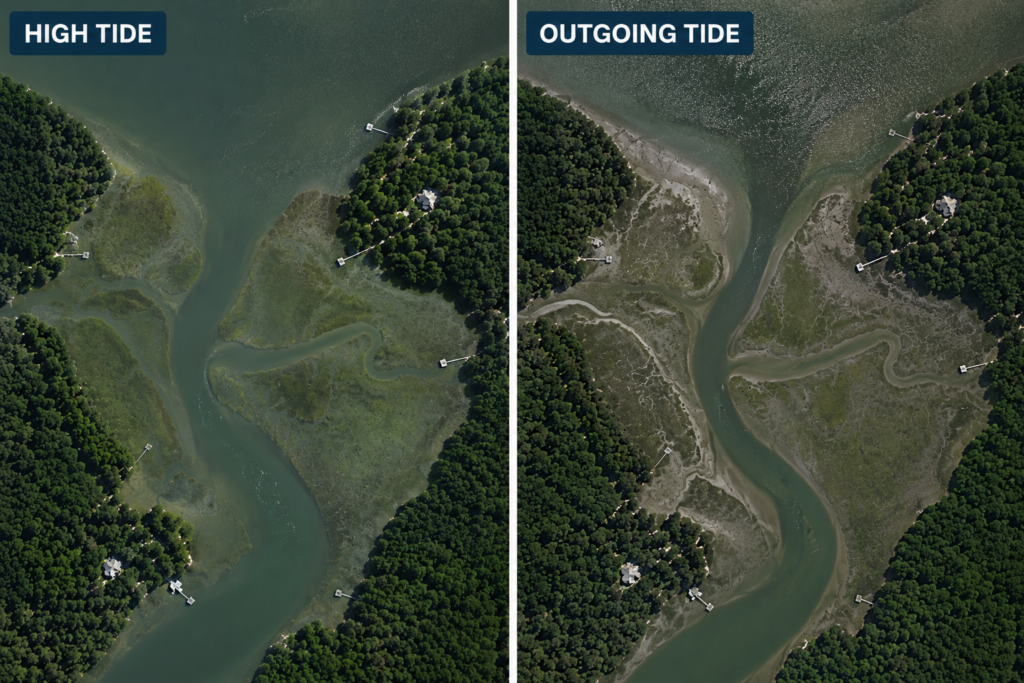
The outgoing tide takes place right after high tide. During slack high tide (when the tide is at its highest and not moving), fish will be all over the place. They have plenty of space to roam and believe me… THEY ROAM. During this time bait fish will swim up into the smaller creeks that bleed into the main water system. Because of this, bigger predatory fish (speckled trout, red drum, black drum, flounder, etc.) are not gonna be feeding much because fish are not predictable.
Fishing a slack high tide is often looked upon as one of the worst times to fish by a lot of anglers. You can catch some good fish at slack high tide but its not nearly as lucrative as an outgoing tide.
During the outgoing tide these predator fish know that the bait fish are gonna be moving. Every bait fish that has went into the small creek channels have to move back out into the main channel because a lack of water. At this time you will find that a lot of these predator fish are going to be sitting at the mouth of these creeks ambushing these bait fish.
How to Fish the During the Outgoing Tide
1. Creek Mouths
My personal favorite way of fishing at this time is fishing creek mouths. Try to position yourself in the main water and cast towards the creek mouths. Often times the mouths of these creeks will be littered with oyster beds and that is a huge plus. This is where the predatory fish will be ambushing bait fish.
2. Grass Lines
Grass lines are a good spot because the grass line offer protection for not only bait fish but also crustaceans. During this time they are pushed into the water and the predatory fish love to ambush them. I have found that the most efficient way to catch fish on grass lines is to use artificial bait and cast parallel to the grass. This allows you to keep your bait in the strike zone longer than if you were to just cast straight into the grass.
3. Docks
Docks are a very good spot to focus when fishing the outgoing tide. During this time large fish will sit under the docks and use them almost as “hunting blinds” to wait for bait fish to come by for protection. These docks create eddies or calm spots that are a place where these predatory fish will sit and wait for food.
My Experience
The last time I inshore fish my family decided to rent a beach house on the inner costal water way so we could do a lot of inshore fishing. During this time when the tide started ebbing I put my kayak into the water and fished 3 different creek mouths that were paddling distance away.
I had very little tackle with me. I was fishing with a 1/8 jig head with. a 3 inch electric chicken Z man paddle tail. The way I was fishing was just casting towards these creek mouths and slowly retrieving. Using this technique I was able to catch some nice redfish and some very respectfully size flounder.
Below is a link to the Z man bait
It will amaze you how easy it is to catch these fish.
Leave a Reply